

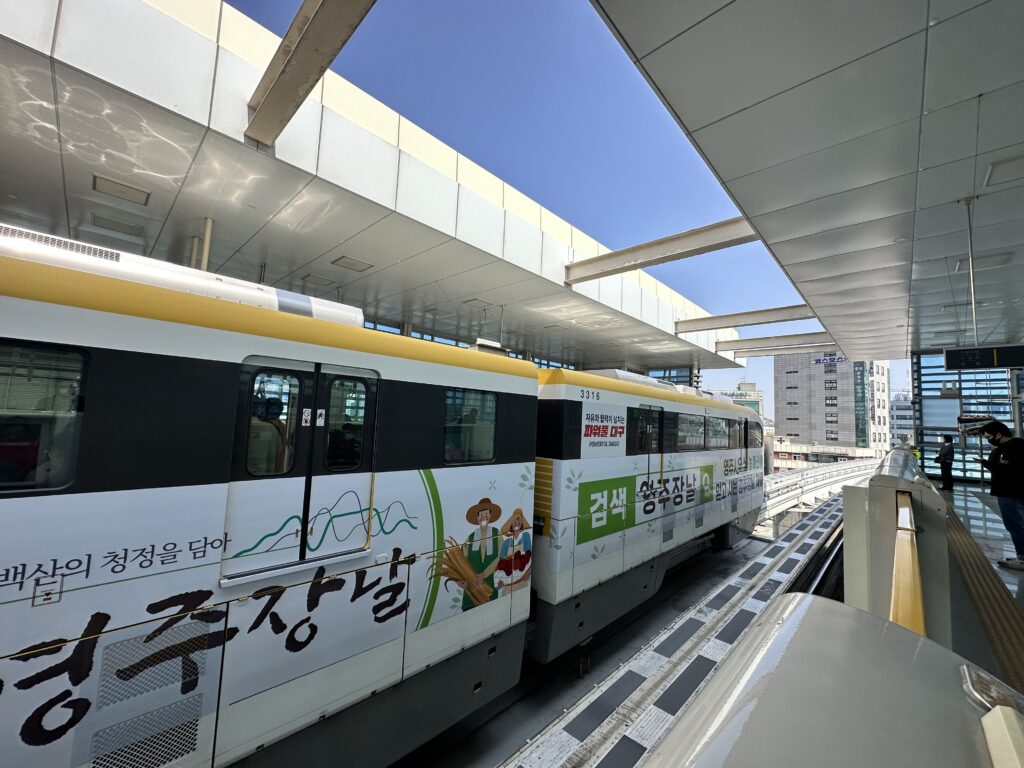
If you are traveling between Seoul and Busan, you actually have two high-speed trains to choose from, not one. Most visitors only hear about the KTX, but the SRT runs almost the same route — and knowing the difference can save you money, a few minutes, or even a seat on a sold-out day.
What is the SRT?
The SRT (Super Rapid Train) launched in 2016 and is run by SR, a separate company from Korail, which operates the KTX. Once both trains leave the Seoul area, they run on the same high-speed line down to Busan, so the ride itself feels much the same. The differences that matter to you are mostly about where you board, where each train can take you, and the price.
The biggest difference: where the train leaves from
This is the one that trips up most foreign travelers. The KTX leaves mainly from Seoul Station and Yongsan, in central Seoul. The SRT leaves from Suseo Station, in the south of the city near the Gangnam area. They are on opposite sides of Seoul, so the simplest rule is to pick the train that departs closest to where you are staying — central Seoul leans KTX, the Gangnam side leans SRT.
The routes differ too. The KTX reaches more of the country, including some destinations the SRT does not serve at all, while the SRT mainly covers the Seoul–Busan and Seoul–Gwangju/Mokpo lines. For Seoul to Busan, both work. For somewhere off those main lines, check that the SRT even goes there before you plan around it.
KTX vs SRT at a glance
| KTX | SRT | |
|---|---|---|
| Operator | Korail | SR (a separate company) |
| Departs Seoul from | Seoul Station / Yongsan (central) | Suseo Station (south, near Gangnam) |
| Destinations | More lines — reaches places the SRT does not | Mainly the Busan and Gwangju/Mokpo lines |
| Price (Seoul–Busan) | Standard fare | About 10% cheaper |
| Speed | A few more stops | Fewer stops, often slightly faster |
| Seats | Outlets not at every seat; some face backward | Outlet at every seat; all face forward |
| Korail Pass | Accepted | Not accepted |
Why this matters when a train is sold out
Because the KTX and SRT sell seats on completely separate systems, a train that shows sold out on one may still have seats on the other. If your KTX is full, it is always worth checking the SRT for the same day and time — and the other way around. It is one of the simplest ways to still reach Busan on a busy weekend or holiday. For more on this, see our guide on what to do when the KTX is sold out.
A 2026 update worth knowing
Since early 2026, the two operators have been running a cross-operation pilot that is gradually expanding, so in limited cases a KTX may leave from Suseo, or an SRT from Seoul Station. For now it still covers only a small number of trains each day, with fuller integration planned later in the year. For almost every trip, you should still treat the KTX and SRT as two separate services with two separate booking sites.
The payment hurdle for foreign travelers
Both trains accept foreign cards in principle, but international cards are often declined at the final step — the checkout may ask for identity verification, 3D Secure, or a Korean phone number, and usually shows only a generic error message. The booking sites can also be hard to follow in English, especially on a phone. This trips up many visitors on both the KTX and the SRT.
What about booking agencies?
If you look for these tickets in English, several booking agencies come up first. They are popular because foreign cards work and everything is in English, and for a simple trip outside peak times they often do the job.
Before you pay, two points are worth keeping in mind. Many of these agencies charge a service fee on top of the official fare, so your total is higher than the real ticket price. And some take “reservations” months ahead, before Korail or SR have even opened sales — which is not a confirmed seat but a request they try to fill later. On a busy weekend or holiday, if it cannot be secured, some travelers only find out a few days before departure that the booking did not go through, once their plans are already set.
And whichever agency you use, it is still a system, not a person. If both trains are sold out, the page simply says so. It will not watch for a returned seat, combine a train with an express bus to get you there on time, or set aside a quiet seat for a family with an infant, extra luggage, or a pet.
Or let us get the seat for you
If you would rather not spend your time refreshing a screen, The Busaner can get the seat for you, on either the KTX or the SRT. We work on a simple ticket system, and a single ticket also covers our train seat-booking service. One ticket covers a 15-minute booking attempt by one of our Korean staff, working in real time with a domestic account — so you can stay focused on your business, daily life, or trip instead of refreshing a screen. You do not need a Korean credit card or a Korean phone number.
If the request needs more than 15 minutes — for example, several seats, a popular route, or a popular time slot — an additional ticket may be needed. We always confirm with you before a ticket is used.
How it works:
- Message us on WhatsApp, LINE, KakaoTalk, or by email using the buttons below.
- Tell us your departure and arrival stations, date, and preferred time.
- We send you a quote first, then you pay through PayPal. New customers choose one of our ticket options, purchase it, and pay the train fare at its original price. If you already hold tickets, you pay only the train fare — at the original price, with no extra charge from us.
- We book your seat in real time.
- Receive your official e-ticket on your phone, by WhatsApp or email.
We accept overseas cards through PayPal, which is trusted and secure worldwide, so you do not need a Korean card or phone number. A card and currency-conversion fee applies to overseas payments — this is not our margin, only what the payment costs us — and your quote always shows it before you pay. Your rights as a customer are protected under our refund policy.
Or message us on your preferred app: