

Air conditioning is essential during a Korean summer, and a sudden breakdown between June and August is hard to ignore. Whether your Samsung AC is leaking water, your LG unit is blowing warm air, or an error code is showing on the display, getting it fixed as a foreign resident has its own obstacles.
For foreign residents in South Korea, the repair itself is rarely the hard part. The friction is in the booking systems that require Korean identity verification, service lines that operate mostly in Korean, and a technician who calls you in Korean before arriving. This guide covers how AC repair in Korea works, a few checks to run first, who pays under Korean rental law, and how to get it handled.
1. Before You Book: Korean Remote Control Modes and Quick Checks
Before paying for a technician, make sure the unit is not simply set to the wrong mode. The remote is labeled in Korean, and it is easy to switch settings by accident. Look for these labels on the remote screen (some remotes show an icon instead of the text):
- 냉방 — Cooling (icon: snowflake). This is the one you want for cold air; set it below room temperature.
- 제습 — Dehumidify (icon: water drop). Reduces humidity but does not cool the room strongly.
- 송풍 — Fan only (icon: fan). Runs the fan with no cooling, so no cold air comes out.
- 난방 — Heating (icon: sun). Switched on by accident, it blows warm air.
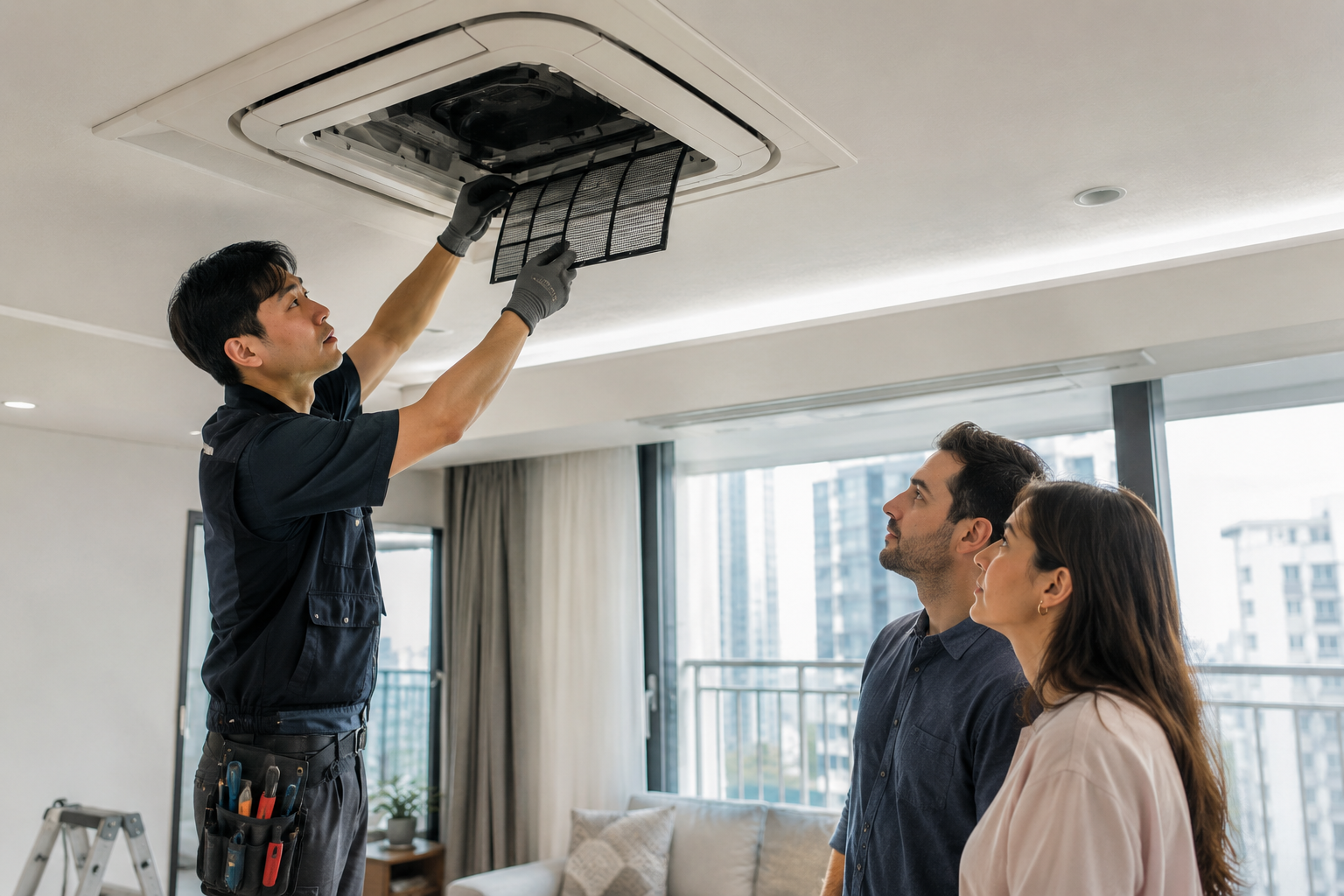
If the unit is set to 냉방 but still blows warm air, or the display shows an error code — for example, CH05 on an LG unit, which signals a communication fault between the indoor and outdoor units — it is time to arrange a repair.
2. Why Booking Is Harder for Foreign Residents (Identity Verification)
Most major brands let you request a repair online, but the booking page usually requires identity verification (본인인증) through the PASS app or an SMS check tied to a Korean phone account and your Alien Registration Card (ARC). This step is a common dead end for:
- Travelers, tourists, or short-term residents who do not have an ARC
- Residents whose phone account name does not match the spelling on their ARC or passport
- Anyone whose PASS app verification will not go through
If your verification goes through, booking online yourself is the quickest route. If it does not, the alternative is to book by phone instead, which does not use the app verification but means working through a Korean-language phone line.
3. Samsung, LG, and Carrier AC Service Phone Numbers
When the online system does not work, calling the brand directly is the next step. These centralized lines handle domestic requests, and dedicated English support is limited; hold times can be long during the summer peak.
Samsung Electronics Service (삼성전자서비스)
1588-3366 — main line for repair requests and product support. Weekdays 09:00–18:00; Saturday hours are limited; Sundays and public holidays closed.
LG Electronics Service (LG전자서비스)
1544-7777 — integrated customer line for LG home appliances. Weekdays 09:00–18:00.
Carrier / Otec Carrier (오텍캐리어 서비스)
1588-8866 — service and repair requests. Carrier units are common as built-in options in officetels and studio apartments. Weekdays 09:00–18:00.
What the visit costs. The diagnostic visit fee (출장비) covers the technician coming out to inspect the unit. Parts and labor are billed separately on top.
Samsung and LG charge more during the summer peak (June–August): roughly ₩30,000–33,000 on a weekday, and about ₩35,000–38,000 in the evening, on weekends, or on public holidays. Outside summer it is closer to ₩25,000–28,000. Carrier’s visit fee generally runs about ₩20,000–30,000.
The Busaner passes these manufacturer repair costs through to you at the actual amount, with no markup.
4. Korean Rental Law: Does the Landlord or Tenant Pay?
If the air conditioner was already installed as a built-in option (옵션) when you signed your lease, the cost is generally the landlord’s responsibility, as long as you did not cause the damage.
Under Article 623 of the Korean Civil Act, a landlord must keep the leased property in a condition fit for use throughout the tenancy.
Korean court precedents draw the line this way: minor problems a tenant can fix easily and cheaply are the tenant’s responsibility, but major repairs, breakdowns from aging equipment, and the replacement of basic fixtures fall to the landlord. A built-in air conditioner that fails from mechanical wear or age usually sits on the landlord’s side of that line.
There are two exceptions. A signed special agreement (특약) can shift some maintenance to the tenant, and a breakdown caused by the tenant’s clear negligence (for example, physical impact, or failing to clear a basic blockage) may be the tenant’s cost.
This is general information, not legal advice. The outcome depends on your specific lease contract and circumstances.
Let your landlord (임대인) know as soon as the AC breaks down. A text gives you a written record and makes reimbursement smoother. You can copy the template below:
안녕하세요 집주인님. 거주 중인 집의 에어컨이 고장 나서 서비스센터에 수리를 신청했습니다. 제 과실이 아닌 일반적인(노후·기계적) 고장일 경우, 수리비는 제가 우선 결제한 뒤 돌려받을 수 있도록 정산 부탁드립니다. 수리가 끝나면 비용과 함께 다시 연락드리겠습니다. 감사합니다.
English: “Hello, the air conditioner in my home has broken down, so I’ve arranged a repair with the service center. If it turns out to be a normal fault (from age or mechanical failure) and not something I caused, I’ll pay for the repair first and would appreciate being reimbursed. I’ll contact you again with the cost once the repair is done. Thank you.”
Prefer not to handle this yourself? The Busaner’s service-center booking is usually covered by a single ticket, and contacting your landlord in Korean — explaining the problem and confirming how the repair cost will be handled — is included in that service.
5. Handling the Technician’s Call and Schedule Changes
Getting an appointment date does not guarantee the repair. In Korea, the technician usually calls your mobile 10 to 30 minutes before arriving to confirm you are home and to ask for a building gate code. This call is in Korean. During the busy summer period, if you do not answer or cannot communicate, the technician will often cancel the slot and move on to the next customer.
Two things are worth knowing here.
- If the call is too hard, switch to text. You do not have to force the conversation. End the call and send a text to the same number instead — this is simple enough to do with a translation app. Confirm the appointment and that you will be home. Do not send your building gate code to a number you cannot verify yet; share it only once you know it is the technician, or when they reach your door.
- Technicians may call to come earlier. When a technician’s schedule opens up during the day, they often call to ask if they can arrive 1–2 hours earlier than booked. Saying yes can save you time during peak season, but it means staying reachable and ready to respond on short notice.
안녕하세요, 에어컨 수리를 [날짜] [시간]에 예약한 ○○아파트 ○○○○호입니다. 한국어가 원활하지 않은 외국인이라 문자로 연락 부탁드립니다. 예약 시간에 집에 있으니 방문하셔도 됩니다.
English: “Hello, this is [apartment name, unit number]. I have an AC repair booked for [date] at [time]. I’m a foreigner and not fluent in Korean, so please contact me by text. I’ll be home at that time, so you can come by.”
6. How The Busaner Can Handle It for You
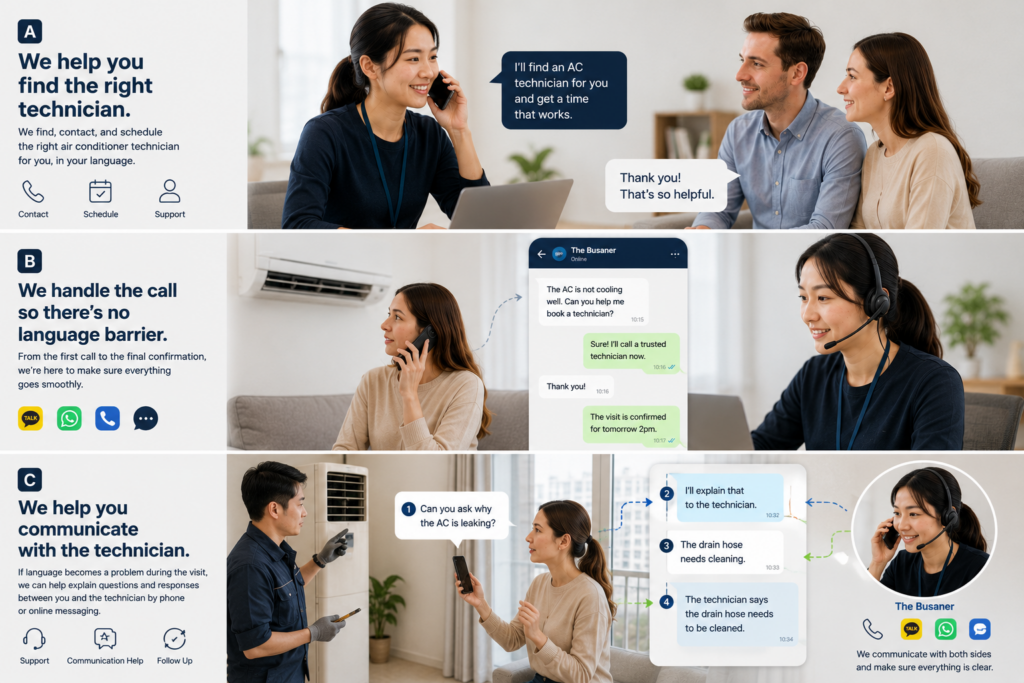
You can arrange this yourself — a translation app or an AI assistant can get you through a basic request. But if you want the appointment locked in quickly (verification problems and the language gap can push your slot back during the peak season), or you would simply rather not deal with it, the Busaner can handle the booking for you.
What we need from you
- The fault (for example: not cooling, leaking water, or an error code on the display)
- The brand and model name of the unit
- Your preferred visit date and time
What we do
We contact the service center and book the repair visit for you. If your preferred date and time are not available — common during the summer peak — we get the open time slots from the center and confirm a new time with you.
If the official service center’s wait is too long, we can also book a trusted independent repair company instead, if you prefer.
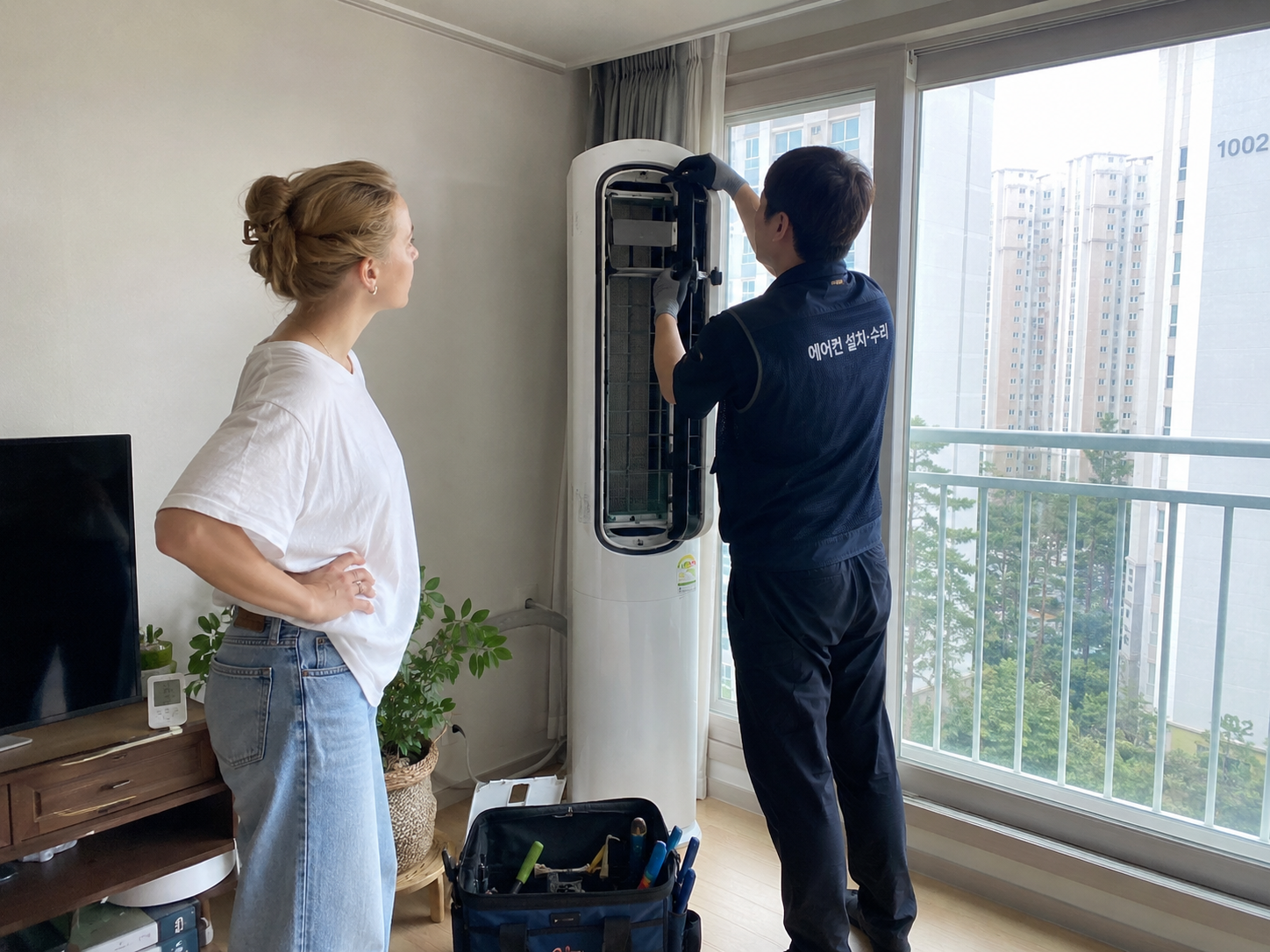
On the day of the visit, we can help you communicate with the technician by phone, and review the proposed repair and the quoted price to check they are reasonable.
Beyond repairs, the Busaner can also handle related needs in Korean: relocating and reinstalling your AC when you move, removing or disposing of an old unit, and buying or selling a used AC on Karrot (당근마켓).
We do not add a markup to the repair. You pay the visit fee, parts, and labor at the actual amount charged by Samsung, LG, or Carrier; our service covers the booking and the scheduling.
A request like this — the booking, plus rescheduling if your preferred time is full — is usually covered by a single Busaner ticket. See the Pricing page for ticket options.
Message the Busaner to get started: