


It’s the middle of the night, your fever keeps climbing or your child won’t stop being sick, and you’re not sure how any of this works here: whether to wait it out, find an open pharmacy, or get to an emergency room, and how you’ll even explain yourself once you’re there. In a new country that uncertainty feels heavier than the illness itself.
The reassuring part: Korea’s medical system is fast, modern and cheap by Western standards, and the language barrier is smaller than it looks, because free interpretation is built into the parts that matter. You don’t need to find an “English-speaking doctor” to get good care here. You need to know the moves.
This is the full how-to for seeing a doctor in Korea as a foreigner, covering both situations you’ll actually face: a real emergency, and the ordinary “I should see a doctor” day. Most of it is the same whether you’re a traveler or living here; where it differs, mainly money, we’ll split it clearly.

Start with one question: is this an emergency?
Almost every wrong move in a foreign medical system comes from getting this fork wrong, treating a real emergency like it can wait, or rushing a head cold to a hospital emergency room where you’ll wait hours and pay far more. So decide this first.
Chest pain or pressure, trouble breathing, signs of a stroke (face drooping, slurred speech, one-sided weakness), heavy bleeding that won’t stop, a severe allergic reaction, a seizure, fainting or unconsciousness, a serious injury or burn, or a high fever in a baby under three months. When in doubt with these, call. The ambulance is free.
For a true emergency, calling 119 first is the safest move, the crew treats the patient on the way and routes you to a hospital that can actually handle it. But if no ambulance can come quickly and the person can be moved safely, flag down a passing taxi, show the driver this, and head for the nearest ER:
지금 응급 상황입니다.
가장 가까운 병원 응급실로 가주세요.
(“This is an emergency. Please take me to the nearest hospital ER.”) While you flag the taxi, call 119 and say “English, please”, describe what’s happening, and they’ll tell you which hospital to head for.
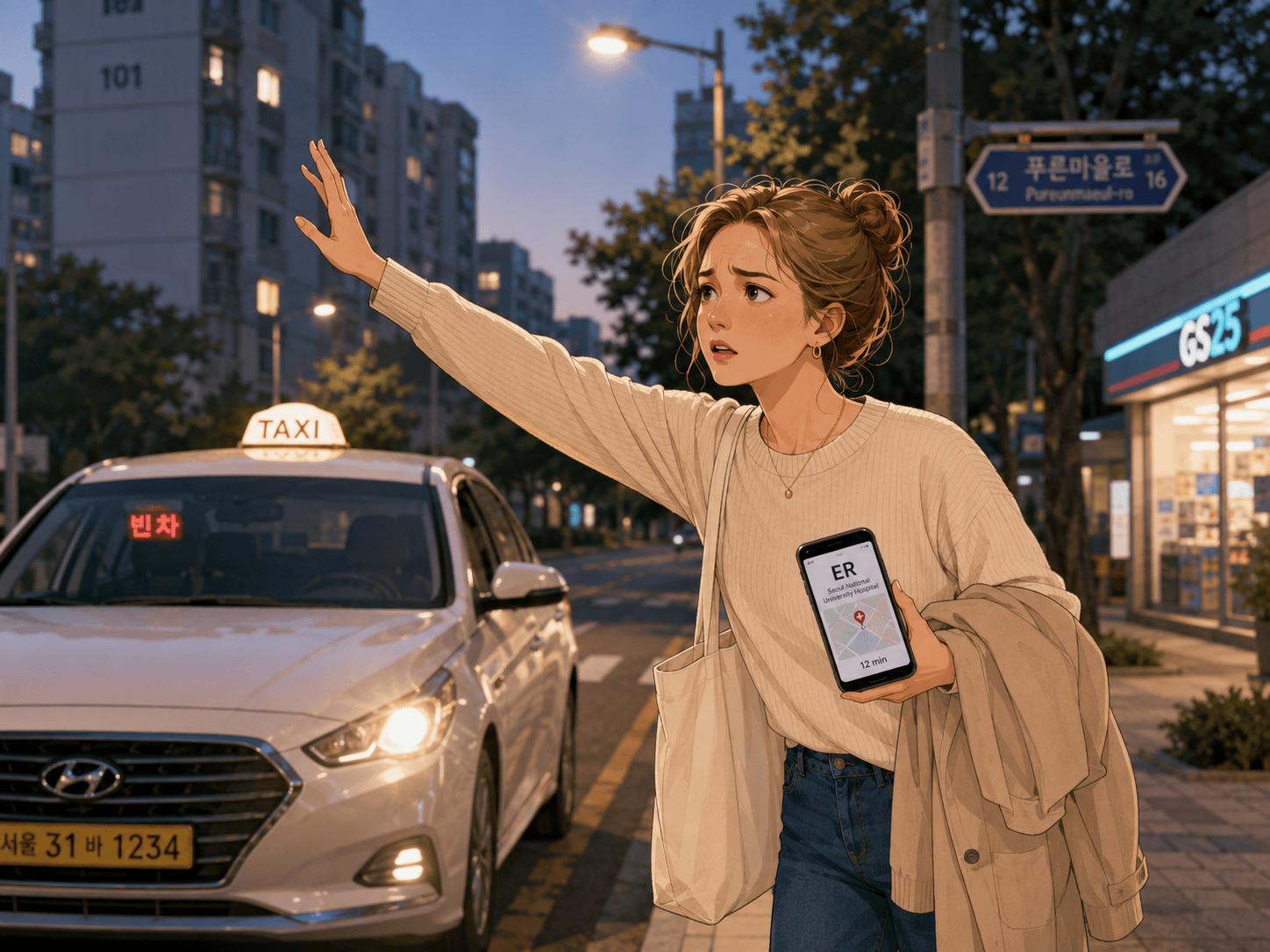
If it’s a cold, a mild fever, a stomach bug, a sprain, a rash, a urinary infection, or a prescription you need refilled, that is not an emergency room visit. A local clinic or even a pharmacy will handle it faster and cheaper. We’ll get to those.
Emergencies: how to call 119 (and what to say)
In Korea, 119 is the single number for fire, ambulance, and medical emergencies, the local equivalent of 911. It works from any phone, including a foreign SIM or eSIM, with no Korean number required, and there’s no area code to remember. The system can locate you through your phone’s GPS or the nearest cell tower, but a landmark speeds things up a lot.
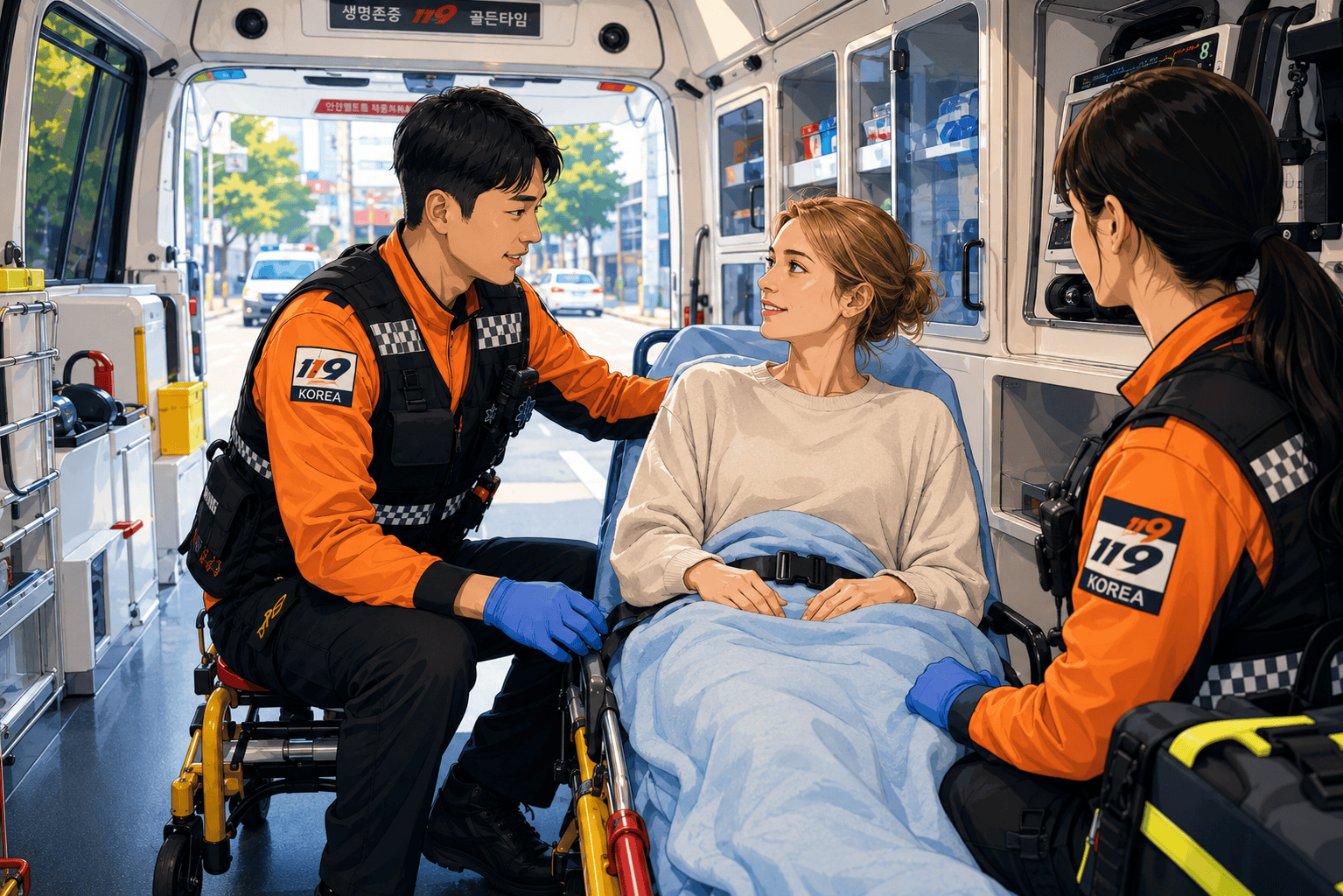
The part foreigners worry about, language, is handled. When a non-Korean speaker calls 119, the operator connects a three-way interpretation call. English, Japanese, and Chinese are the most readily available; other languages are reachable too. Here’s the catch worth knowing in advance: the operator usually answers in Korean and it can take a short moment to bring the interpreter on. Don’t panic and don’t hang up.
1. Say clearly: “Hello, English, please.” (or your language)
2. Wait on the line. You may hear Korean for ~20–30 seconds while they connect the interpreter. Stay on.
3. Give your location: nearest big building, subway station and exit number, or your address. A landmark beats GPS.
4. Describe the problem in plain words: what happened, and whether the person is conscious, breathing, or bleeding.
Calling from home and not sure you’ll be able to open the door yourself? Tell the dispatcher your entry codes, the building’s main-entrance (현관, hyeon-gwan) keypad code and your unit’s door-lock (도어락, do-eo-rak) code, so the paramedics can get in and reach you.
If your Korean is zero and the transfer makes you nervous, there’s a shortcut: call 1330 (the Korea Travel Hotline, staffed 24/7 in English and other languages) and ask them to connect you to 119. They’ll bridge the call with interpretation from the start. For crime or personal-safety emergencies, the police number is 112, which has the same kind of interpretation support.
One correction worth making, because a lot of older guides get it wrong: you may see articles telling you to call 1339 for medical advice or to find a hospital. That old emergency-medical line was folded into 119 back in 2013. Today 119 itself gives round-the-clock medical consultation and can tell you whether to come in. The number 1339 now belongs to the national disease-control agency (KDCA) for infectious-disease questions, not your sprained ankle.
At the emergency room
Here’s the part that saves the most stress: you don’t have to work out which hospital on your own, and you shouldn’t be cold-calling Korean ERs yourself. That’s what 119 is for. Even when you don’t need an ambulance, and most of the time you won’t, its medical line runs 24 hours and will tell you which open hospital fits your situation, factoring in the hour and how busy each one is. Ask, and it can send you a shortlist of hospitals by text; then you make your own way there.
You reach 119 by phone, with an interpreter on the line, and if speaking is hard or your Korean is limited, also by text message (SMS/MMS), its app, or a video call, a “multi-channel” service open to anyone in Korea.
For most everyday problems this won’t come up, the emergency-medicine doctors on duty handle the bulk of what comes into an ER. It matters when you need a specific specialist, a pediatrician for a child, say. Here’s the catch: a hospital can be listed or scheduled to have that specialist on duty today, yet whether they’re actually in the building and free at that moment can shift with the hospital’s and the doctor’s own schedule. So the list 119 sends you tells you where to start, not that the specialist is definitely there right now. The safe move is a real-time call to confirm before you set off, and that confirming call, in Korean, mid-emergency, is exactly the part an individual usually can’t manage alone.
Once you’re there, a few things make the visit smoother:
- Bring ID and any coverage proof. Passport or Alien Registration Card (ARC); your health insurance card if you’re a resident; your travel-insurance details if you’re a visitor.
- You usually pay after treatment, occasionally before you’re discharged. Keep every receipt.
- Interpretation exists here too. Many large and university hospitals have an International Healthcare Center with in-house interpreters. When that’s not on hand, a free phone interpreter (see the list further down) covers the gap.
Not an emergency: how to actually see a doctor
For everyday illness, Korea runs on a tiered system, and using it in the right order keeps things cheap and quick.
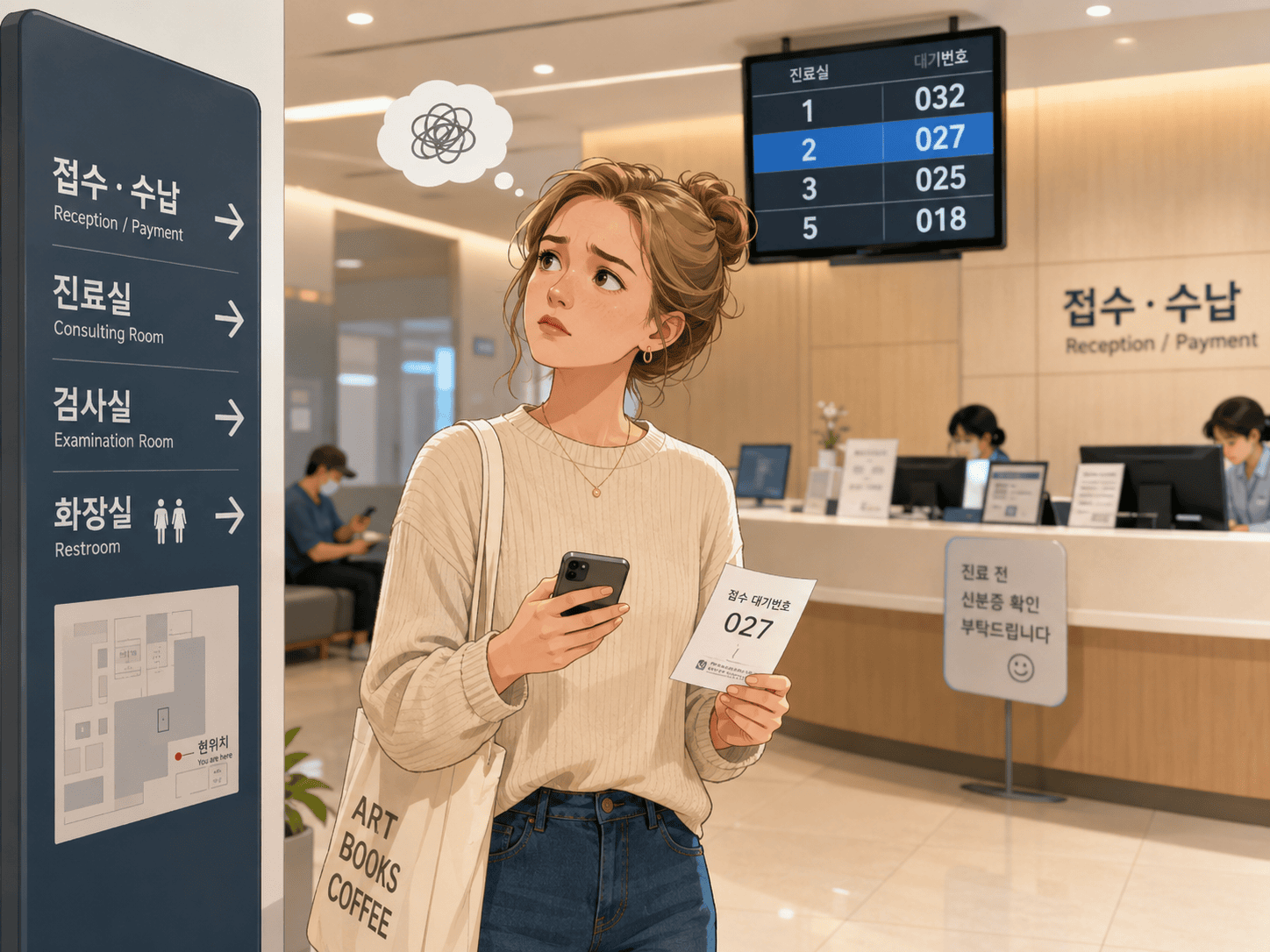
- Tier 1 — Local clinic (의원, uiwon) — small neighborhood practices, everywhere, usually no appointment needed. Walk in, register, and you’re typically seen within 20–30 minutes. Start here for almost everything.
- Tier 2 — Hospital / general hospital (병원 / 종합병원, byeongwon / jonghap byeongwon) — bigger, for things a clinic refers onward or that need inpatient care.
- Tier 3 — Tertiary hospital (상급종합병원, sanggeup jonghap byeongwon) — the major university medical centers, for serious and complex cases.
Clinics are signposted by specialty, so you can pick by symptom rather than explaining much:
- Internal medicine (내과, naegwa) — colds, flu, fever, stomach trouble, general illness.
- ENT (이비인후과, ibiinhugwa) — sore throat, ear infections, sinus pressure, nasal congestion.
- Orthopedics (정형외과, jeonghyeongoegwa) — sprains, fractures, joint pain, back pain.
- Dermatology (피부과, pibugwa) — rashes, skin allergies, acne.
- Pediatrics (소아청소년과, soacheongsonyeongwa) — infants, children, teenagers.
- Also — OB/GYN (산부인과, sanbuingwa), ophthalmology (안과, angwa), dentistry (치과, chigwa).
The easiest way is Google Maps in English, search “internal medicine clinic” or “ENT clinic” near you and you’ll get nearby options with hours, reviews and a call button. (Naver Map and KakaoMap carry the fullest Korean listings; you can copy the Korean department names from the tables further down and paste them into the search box.) Once you arrive, a translation app like Papago covers the front desk. Not sure which kind of clinic fits your symptom? 119’s 24-hour line will point you. And if you’re too unwell to get there on your own, call a taxi, or, if it’s serious enough, call 119 for an ambulance.
To use your insurance at a tertiary hospital (상급종합병원) for an outpatient visit, you need a referral (진료의뢰서, jillyo-uiroeseo) from a clinic or hospital first. Walk in without one and you pay the full, uninsured price. Emergencies are exempt, and so is the family medicine department (가정의학과, gajeong-uihak-gwa) at a big hospital, which can also write the referral that opens the rest of it to your insurance. So for routine problems, begin at a local clinic, it’s cheaper, faster, and it’s the door that opens the rest of the system.
The visit itself is simple: at reception you give your name and ID and they’ll ask if it’s your first time and whether you have insurance. You see the doctor, then pay at the front desk on the way out, and that’s when you’re handed your prescription (처방전, cheobangjeon); take it to a pharmacy, usually the one on the ground floor of the same building, to pick up your medicine.
Korean consultations are short and efficient, often under ten minutes; that’s the norm here, not a brush-off. And you don’t need to track down an “English-speaking doctor” to be treated well. Many doctors manage basic exam-room English even if they’re not fluent, and a translation app like Papago or Google Translate covers the rest; point to where it hurts, show a phrase from the list below, and the doctor takes it from there.
When clinics are closed: nights, Sundays, holidays
Most clinics shut in the evening and on Sundays, which is exactly when fevers spike. You still have options short of the ER:
- Kids: Moonlight Children’s Hospitals (달빛어린이병원, Dalbit eorini byeongwon) — a national program of pediatric clinics open late on weeknights and on weekends/holidays. For a child’s mild fever, vomiting, or cold, this is faster and far cheaper than an ER. Copy 달빛어린이병원 into Google Maps or Naver Map to find the nearest one, then show the address to your taxi driver or drop it into the navigation and go.
- Adults: night/holiday clinics and 24-hour pharmacies. Most cities have them; the trick is finding which one is open right now.
- Many 24-hour convenience stores carry a small set of basic over-the-counter medicines, fever reducers, painkillers, cold and digestive remedies, when even pharmacies are shut. Not every store stocks them and the range is limited, but it’s a real backstop at 3 a.m.
The simplest answer, again, is 119: its 24-hour line guides you to night and holiday clinics and 24-hour pharmacies too, not only ERs. If you’d rather look yourself, E-Gen (e-gen.or.kr or the “응급의료정보제공” app from the Ministry of Health) lists open hospitals, pharmacies and live ER bed availability, though it’s mostly in Korean, and on Google Maps you can search “emergency room” or “24 hour pharmacy” in English.
Pharmacies (약국): your first stop for minor things

A Korean pharmacy (약국, yakguk, look for the character 약 on the sign, often a green or red cross) is more useful than its Western equivalent. For minor issues you can skip the doctor and describe symptoms to a pharmacist; they recommend an over-the-counter medicine on the spot.
Lead with the symptom rather than a brand name from home; the formula and dose here may differ. The pharmacist may ask how long it’s been going on, whether you have a fever, what else you’re taking, and whether you want something non-drowsy, useful questions, not obstacles. A translation app or a short note covers anything your Korean doesn’t.
The money part: insurance and what you’ll actually pay
This is where travelers and residents diverge, so here it is split cleanly.
Resident If you live here: National Health Insurance
Korea’s National Health Insurance (국민건강보험, NHIS) is the single public system nearly everyone is on. Enrollment is mandatory for most foreigners after six months of residence; if you’re employed, your company enrolls you from day one and splits the premium with you; international students (D-2), marriage migrants (F-6) and permanent residents (F-5) don’t have to wait the six months either.
The system covers roughly 60–80% of most medical costs, and you pay the remainder, your out-of-pocket share (본인부담금, bonin-budamgeum):
| Where you go (outpatient) | You pay |
|---|---|
| Local clinic (의원) | 30% |
| Hospital / general hospital (병원·종합병원) | 40% |
| Tertiary hospital (상급종합병원) | 50% |
In real money, a simple cold visit with prescribed medicine often comes to around ₩6,000–12,000 once you’re insured. And there’s a backstop most people never notice until they need it: an annual out-of-pocket cap (본인부담상한제, bonin-budam sanghanje) limits what you can be charged in a year, so a serious illness won’t bankrupt you. NHIS runs a multilingual line at 033-811-2000 (English, Chinese, Uzbek, Vietnamese) if you need to check your enrollment or premium.
Traveler If you’re visiting (or still in your first six months)
Without NHIS you pay the full price, but “full price” in Korea is still low compared with much of the West. A clinic visit with medicine runs into the tens of thousands of won. An emergency-room visit without insurance is commonly in the ₩100,000–400,000 range, rising past ₩600,000 if you need a CT or MRI scan. You usually pay after treatment. The smart move is simple: carry travel insurance, pay upfront, and keep two documents to claim it back, the itemized receipt (진료비 영수증, jillyobi yeongsujeung) and, if asked, a medical certificate (진단서, jindanseo).
If the doctor orders tests: blood work, X-rays, scans
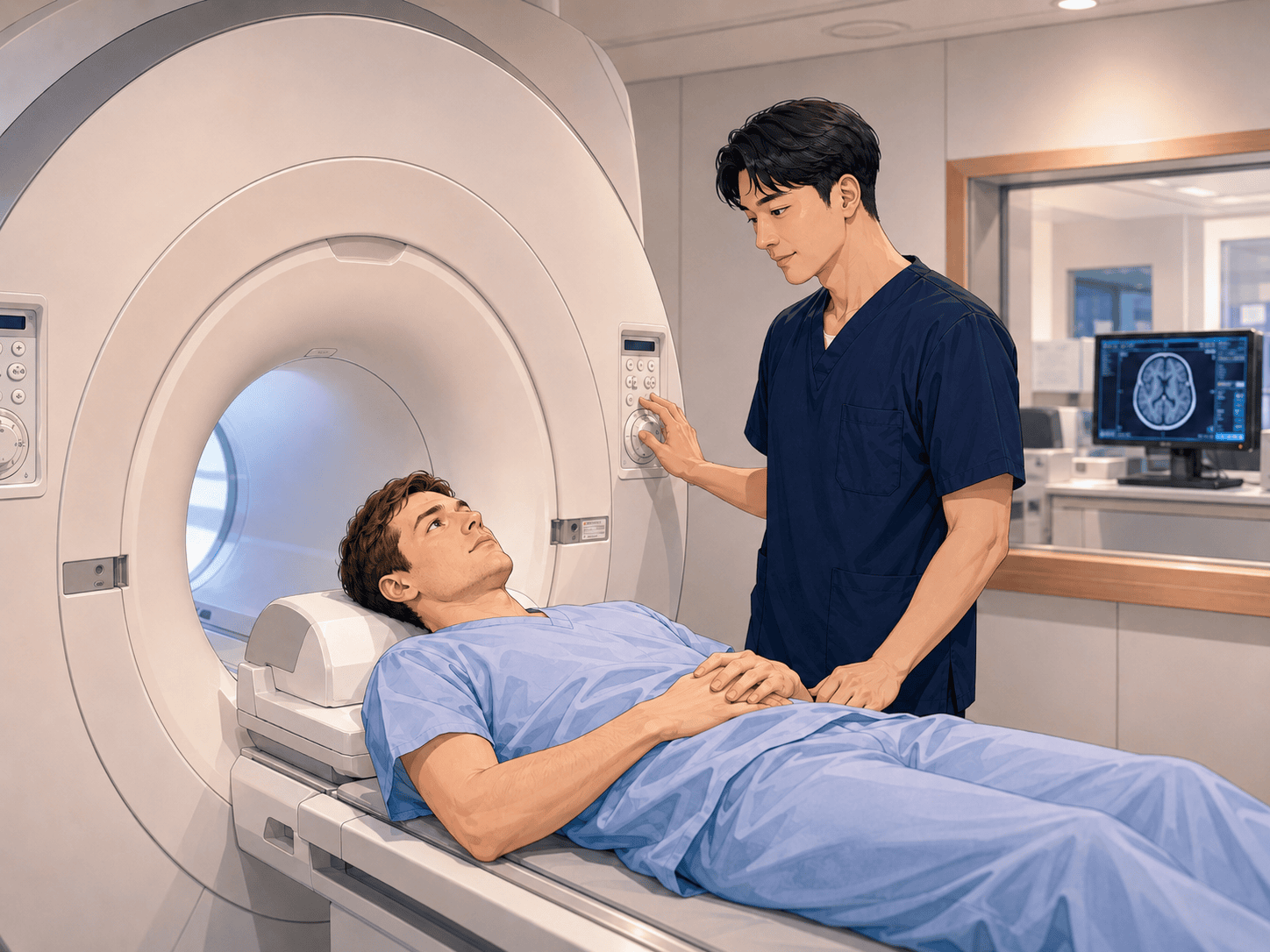
Korean doctors order tests readily, and the same visit often includes them on the spot. A blood test (혈액검사, hyeolaek-geomsa, or just 피검사, pi-geomsa), a urine test (소변검사, sobyeon-geomsa), an X-ray (엑스레이, ekseurei) or a basic ultrasound (초음파, choeumpa) are usually done the same day in the same building, and they’re inexpensive, modest with insurance and still low without it. Blood and urine results are often back the same day or the next.
The tests that move the bill are the scans: a CT (씨티, ssiti) or an MRI (엠알아이, emarai). Here the question that matters isn’t the machine, it’s whether the test is covered.
Resident When a doctor orders a CT or MRI because they genuinely suspect a condition, National Health Insurance covers it and you pay only your tier copay (30/40/50%). But if a scan is elective, your own request, or not medically indicated, a brain MRI for an ordinary long-running headache when the exam comes back normal, for instance, it is not covered, and you pay the full price, commonly several hundred thousand won. The doctor must explain this and get your written consent before any non-covered test, so you’ll know before it happens.
Traveler Without insurance you pay full price for everything. Routine tests stay cheap; a CT or MRI is the expensive line, often in the hundreds of thousands of won and varying widely by hospital and body part. Keep the itemized receipt for your travel-insurance claim.
A couple of things help here. You won’t be ambushed by a big bill: a doctor has to explain a non-covered test and get your written consent before going ahead, so the cost surfaces before it happens, not after. And for the same covered scan, a local clinic or general hospital is usually cheaper than a tertiary hospital. Smaller clinics often handle blood draws, X-rays and ultrasound themselves; for a CT or MRI they may send you to a hospital or imaging center.
Free interpretation: save these before you need them
You don’t have to gamble on whether a clinic happens to have an English speaker. Several services will interpret for you, free, including by phone in the middle of a consultation.
119 — emergencies; interpreter joins via three-way call.
1330 — Korea Travel Hotline, 24/7 in English and other languages. Will interpret on a call (e.g. with a clinic) and can bridge you to 119.
BBB Korea, 1588-5644 — free volunteer phone interpreters, 24/7, around 20 languages, app available. Built for exactly this: clinics, pharmacies, the ER.
Medical Korea, 1577-7129 — a government foreign-patient support line (English, Chinese, Japanese, Russian) that helps you choose a hospital, book the appointment, and arrange an interpreter. Daytime hours.
1345 — Immigration Contact Center, 20 languages, for residents’ visa and admin questions.
Hospital International Healthcare Centers (국제진료센터) at major university hospitals, the big Seoul hospitals as well as ones in other cities nationwide, handle registration, interpretation, payment and paperwork in one place.
City-level help exists too: Seoul runs an in-person medical-interpreter program (MeSic) for residents’ bigger appointments, and the Busan Global Center (1577-7716) supports foreign residents on weekdays.
Common illnesses and symptoms in Korean
You don’t have to memorise any of this. Show the Korean to the staff, or paste it into a translation app like Papago or Google Translate, both of which read it aloud for you. The two lists below cover the names you’ll most likely need to recognise and the symptoms you’ll most likely need to describe.
Common illnesses
| English | Korean | Pronunciation |
|---|---|---|
| A cold | 감기 | gam-gi |
| The flu (influenza) | 독감 | dok-gam |
| COVID-19 | 코로나 | ko-ro-na |
| Food poisoning | 식중독 | sik-jung-dok |
| Stomach bug / gastroenteritis | 장염 | jang-yeom |
| Indigestion / upset stomach | 소화불량 | so-hwa-bul-lyang |
| UTI / cystitis | 방광염 | bang-gwang-yeom |
| Pink eye / conjunctivitis | 결막염 | gyeol-mak-yeom |
| Ear infection / otitis media | 중이염 | jung-i-yeom |
| Sinus infection / sinusitis | 부비동염 | bu-bi-dong-yeom |
| Tonsillitis | 편도선염 | pyeon-do-seon-yeom |
| Migraine | 편두통 | pyeon-du-tong |
| Hives | 두드러기 | du-deu-reo-gi |
| Allergy | 알레르기 | al-le-reu-gi |
| Sprain | 염좌 (삠) | yeom-jwa (ppim) |
| Heat exhaustion | 일사병 | il-sa-byeong |
| Heatstroke | 열사병 | yeol-sa-byeong |
| Motion sickness | 멀미 | meol-mi |
Describing your symptoms
| English | Korean | Pronunciation |
|---|---|---|
| It hurts here. (point) | 여기가 아파요 | yeo-gi-ga a-pa-yo |
| I have a headache. | 머리가 아파요 | meo-ri-ga a-pa-yo |
| I have a stomachache. | 배가 아파요 | bae-ga a-pa-yo |
| I have a sore throat. | 목이 아파요 | mog-i a-pa-yo |
| I have chest pain. | 가슴이 아파요 | ga-seum-i a-pa-yo |
| I have a fever. | 열이 나요 | yeor-i na-yo |
| I have a cough. | 기침이 나요 | gi-chim-i na-yo |
| I have a runny nose. | 콧물이 나요 | kon-mul-i na-yo |
| I threw up. | 토했어요 | to-haess-eo-yo |
| I have diarrhea. | 설사해요 | seol-sa-hae-yo |
| I feel dizzy. | 어지러워요 | eo-ji-reo-wo-yo |
| I have the chills. | 오한이 나요 | o-han-i na-yo |
| My whole body aches. | 몸살이 났어요 | mom-sar-i nass-eo-yo |
| I can’t breathe well. | 숨쉬기 힘들어요 | sum-swi-gi him-deur-eo-yo |
| I’m allergic to this. | 이거 알레르기가 있어요 | i-geo al-le-reu-gi-ga iss-eo-yo |
Quick answers (FAQ)
Can foreigners see a doctor in Korea?
Yes. Anyone can be seen with a passport or ARC, and you can walk into a local clinic with no appointment for most things. With National Health Insurance you pay a small share of the cost; without it you pay the full price, which is still low by Western standards.
What is the emergency number in Korea?
119, for both an ambulance and medical emergencies (not 911). It’s free, runs 24 hours, and connects a three-way interpreter when you say “English, please.” The police number is 112.
How much does it cost to see a doctor in Korea without insurance?
A clinic visit with medicine usually runs into the tens of thousands of won. An emergency-room visit without insurance is commonly ₩100,000–400,000, more if you need a CT or MRI. With National Health Insurance, a simple cold visit is often around ₩6,000–12,000.
Do doctors in Korea speak English?
Not usually fluently, but more than you’d expect. Korean medical training runs largely on English, so many doctors can manage basic exam-room English even when they can’t hold a casual conversation, and international clinics and major hospitals in big cities go further. Either way, you don’t need an English-speaking doctor: a translation app like Papago or Google Translate handles a basic consultation, and 1330 or BBB Korea (1588-5644) give free phone interpretation when you want a real person.
Do I need an appointment, or can I just walk in?
For a local clinic, walking in is normal, and usually the practical choice, since booking by phone in a foreign language is hard at most small clinics. Expect some wait even then; after a first visit the clinic will often schedule your follow-up, though an appointment time is more “roughly then” than a promise of being seen on the dot. Plastic surgery, dermatology and serious conditions are different: these usually need an appointment even for a first visit, booked directly with the clinic. And to use your insurance at a tertiary (university) hospital, you need a referral from a clinic first.
Where do I get my medicine?
At a pharmacy (약국), not the clinic, Korea separates prescribing from dispensing. You’re handed a prescription when you pay at the counter on your way out; take it to a pharmacy, ideally the one on the ground floor of the same building, because a pharmacy further away may not stock the exact medicine prescribed. Basic over-the-counter medicines are sold at pharmacies too, and a few at 24-hour convenience stores.
Where we come in
The free public services above cover a lot, and for emergencies and “where do I go right now” questions, 119 is genuinely the answer. Where people still get stuck is further along: when 119 and the free help don’t get you smooth, satisfying care; when you’ve already seen a doctor but you’re not getting better and want a stronger hospital; or when the choice of clinic matters enough that you want the decision made well the first time.
That’s where we come in. Online, anywhere in Korea, we research and shortlist the right clinic or hospital for your situation, book the appointment with a clinic that only answers in Korean, and set up interpretation. For an emergency, we can put the question to 119 ourselves, work through the hospital list it returns, and call each candidate in Korean to confirm which one actually has the specialist you need available right now, then point you to the best fit, so you’re not left guessing from a list you can’t act on.
We also take care of the small things that wear you down while you’re ill, ordering medicine and a warm bowl of juk (죽, rice porridge, the Korean sick-day staple) to your door, for instance. And if a first hospital hasn’t worked and you’re no better, we look for a stronger one and get you in.
This matters most when there are many providers and the choice itself is the hard part. With elective and cosmetic care, plastic surgery, dermatology, aesthetic procedures, the clinic you pick and how well you grasp the consultation decide whether you walk away happy. A full health checkup (건강검진, geon-gang-geomjin) is the same story: dozens of screening centers with wildly different packages and prices, and no easy way to tell which one fits you.
We vet the options on reputation and track record, compare packages, line up and interpret the consultations, and, where we work in person, Busan, Ulsan, Daegu and the wider Gyeongsang region (including Geoje Island), we come with you (quoted per visit) so nothing is lost in translation. Somewhere outside those regions? Message us anyway, we can often arrange in-person help on request. We research, coordinate and interpret; the doctors provide the care. Hand the whole thing over, or call us in partway, both are welcome.
Beyond medical visits, that’s how we work across the board, any legal, doable request in Korea: reservations, orders, research, bookings, admin, the things an app or a translation tool can’t quite finish or that are just a hassle in another language. Online tasks run on a simple per-task basis (about 15 minutes of real-time help each); in-person accompaniment is quoted per visit. Message us in your own language and we’ll take it from there.
This article is general information for getting around Korea’s healthcare system, not medical advice. For any life-threatening situation, call 119 immediately. Service details and government numbers are accurate at the time of writing; public programs can change.